
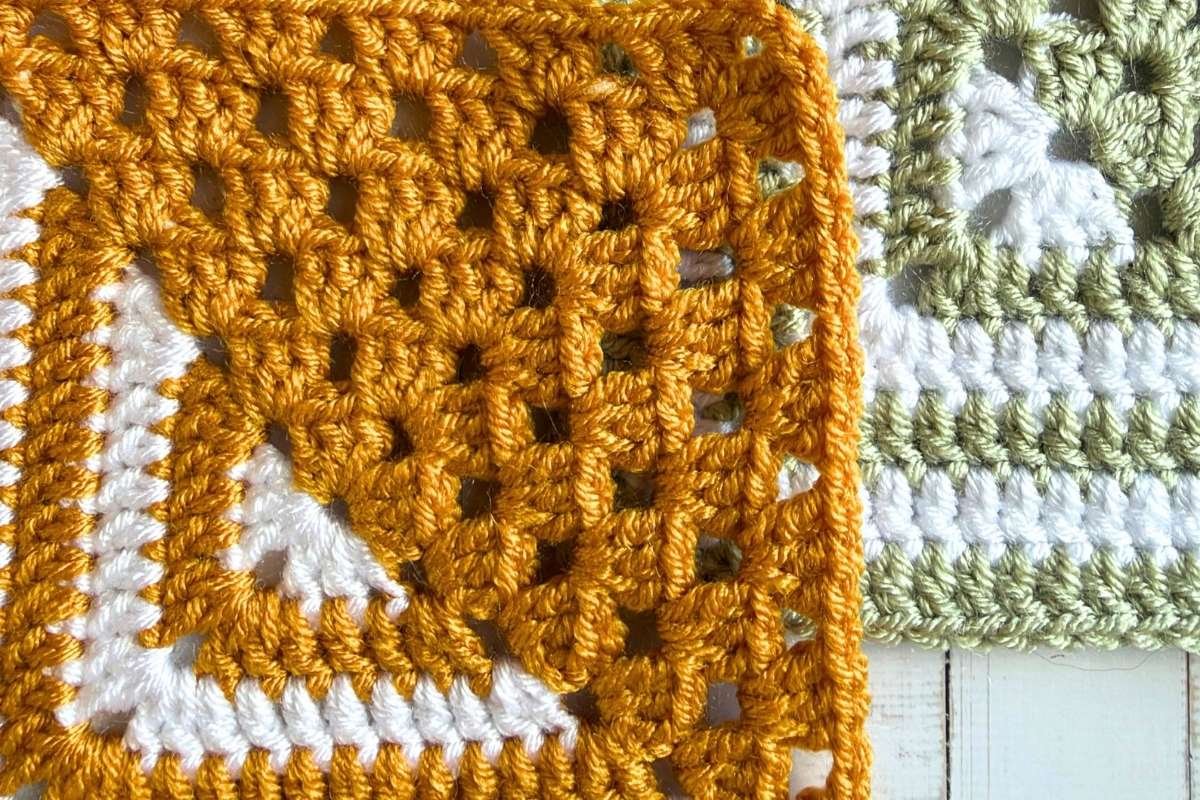
Give the traditional granny square a fresh new look with this Crochet Split Granny Square. Combining classic granny clusters with solid double crochet stitches, this design brings two familiar crochet techniques together in one eye catching square.
The open granny section creates that timeless, recognisable pattern, while the opposite half features solid double crochet rows accented with contrasting stripes. The result is a beautifully balanced design that looks equally lovely in neutral shades or bold colour combinations.
Whether you’re creating a cosy blanket, a. decorative cushion or experimenting with different granny square designs, this square offers something a little different from the traditional favourite.
About the Crochet Split Granny Square
The Crochet Split Granny Square is worked in rounds, combining two distinct stitch patterns within the same motif.
One half features traditional granny clusters consisting of groups of three double crochet stitches separated by spaces. These clusters create the familiar open appearance associated with classic granny squares.
The other half is worked using solid double crochet stitches, forming a denser fabric. Contrasting colour changes introduce stripes that follow the shape of the square adding definition to the design.
Although the two halves have noticeably different appearances, they come together to create one continuous square.
This design is particularly effective when worked in two complimentary colours, allowing the differences between the open and solid sections to stand out.
Crochet Split Granny Square at a Glance
- Skill level: Intermediate
- Construction: Worked in joined rounds
- Main stitches: Double crochet, half double crochet and slip stitches
- Design: Half traditional granny clusters and half solid double crochet
- Colourwork: Two contrasting colours
- Shape: Square
- Terminology: US crochet terms
Abbreviations
- ch – chain
- hdc – half double crochet
- dc – double crochet
- sl st – slip stitch
- st(s) – stitch(es)
- sp – space
- tch – turning chain
- rep – repeat
Pattern notes
- The square is worked from the centre outwards.
- One section uses traditional granny clusters while the opposite section is worked in solid double crochet.
- Contrasting colour changes create stripes across the solid portion of the square.
- The design can be made larger by continuing the established stitch pattern.
- Keep your tension consistent when transitioning between the clusters and solid double crochets.
- The beginning ch 3 counts as the first stitch.
- Blocking the finished square will straighten the edges and define corners.
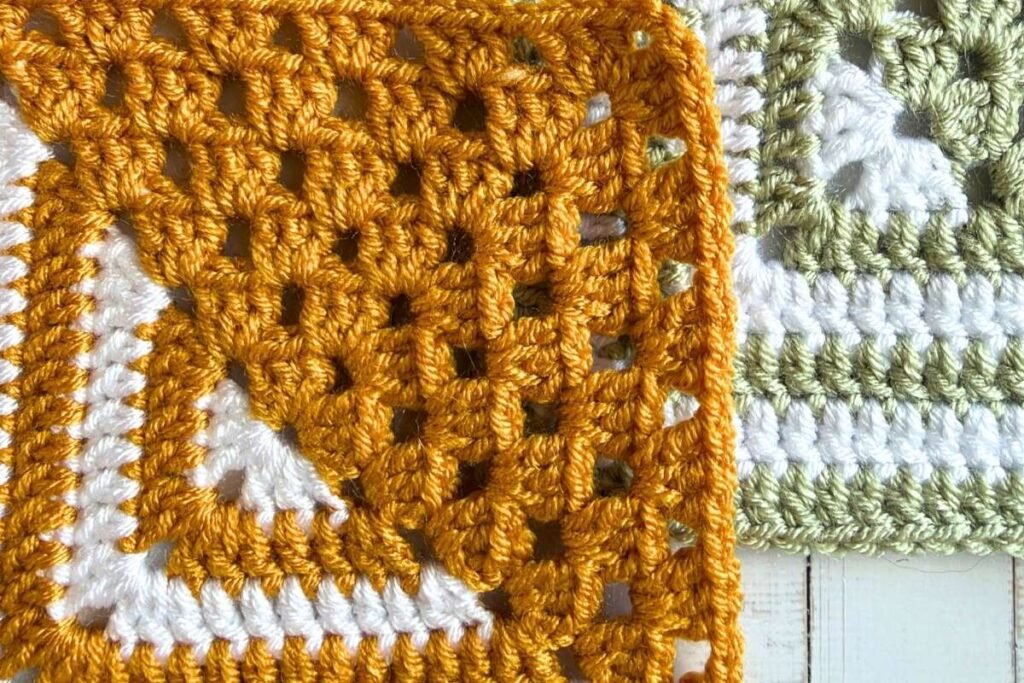
How to Crochet the Split Granny Square
Make a magic ring using colour A
Carry each colour across your work by crocheting the second strand behind your stitches.
Round 1:
Ch 3, 2dc, ch 2, 3dc (CHANGE TO COLOUR B AT THE LAST YO OF THE LAST DC), ch 2, 3dc, ch 2, 3dc (CHANGE TO COLOUR A AT THE LAST YO OF THE LAST DC), ch 1, hdc to the 3rd ch of tch.
Round 2:
Ch 3, 2dc in sp directly underneath, ch 1, (3dc, ch 2, 3dc) in next sp, ch 1, (3dc, ch 2, 2dc) in next sp, dc in each of the next 3 dc, (2dc, ch 2, 2dc) in next sp, dc in each of the next 3 dc, (2dc, ch 1) in last sp (where you began first cluster of the round), hdc in the 3rd ch of the tch.
Round 3:
Ch 3, 2dc in sp directly underneath, ch 1, 3dc in next sp, (3dc, ch 2, 3dc) in next sp, ch 1, 3dc in next sp, ch 1, [3dc (CHANGING TO COLOUR B AT THE LAST YO OF THE LAST DC), ch 2, 2dc] in next sp, dc in each of the next 7 dc, (2dc, ch 2, 2dc) in next sp, dc in each of the next 7 dc, 2dc in last sp (CHANGE TO COLOUR A AT THE LAST YO OF THE LAST DC), ch 1, hdc in the 3rd ch of the tch.
Round 4:
Ch 3, 2dc in sp directly underneath, ch 1, (3dc, ch 1 in next sp) twice, (3dc, ch 2, 3dc) in next sp, ch 1, (3dc, ch 1 in next sp) twice, (3dc, ch 2, 2dc) in next sp, dc in each of the next 11 dc, (2dc, ch 2, 2dc) in next sp, dc in each of the next 11 dc, 2dc in last sp, ch 1, hdc in the 3rd ch of the tch.
Round 5:
Ch 3, 2dc in sp directly underneath, ch 1, (3dc, ch 1) 3 times, (3dc, ch 2, 3dc) in next sp, ch 1, (3dc, ch 1) 3 times, [3dc (CHANGING TO COLOUR B AT THE LAST YO OF THE LAST DC), ch 2, 2 dc] in next sp, dc in each of the next 15 dc, (2dc, ch 2, 2dc) in next sp, dc in each of the next 15 dc, 2dc in last sp CHANGE TO COLOUR A AT THE LAST YO OF THE LAST DC, ch 1, hdc in the 3rd ch of the tch.
Round 6:
Ch 3, 2dc in sp directly underneath, ch 1, (3dc, ch 1) 4 times, (3dc, ch 2, 3dc) in next sp, ch 1, (3dc, ch 1) 4 times, (3dc, ch 2, 2dc) in next sp, dc in each of the next 19 dc, (2dc, ch 2, 2dc) in next sp, dc in each of the next 19 dc, 2dc in last sp, ch 1, hdc to the 3rd ch of the tch.
Crochet Split Granny Square FAQs
Is the crochet Split granny Square suitable for beginners?
This design is best suited to crocheters who are already comfortable working traditional granny squares and double crochet stitches. Although the individual stitches are easy, switching between the open granny section and the solid double crochet section requires a little more attention.
Can I use different yarn weights?
Yes! You can experiment with different yarn weights to achieve a variety of finished sizes and appearance. For reference, I used a weight 3/dk yarn with a 3.5 mm hook.
Can I make the square larger?
Of course! The design can be extended by continuing the established granny cluster and solid double crochet sections, ensuring that the necessary corner increases are maintained.
Do I have to use two colours?
Not at all. Although contrasting colours help emphasise the striped design, the square can also be worked in a single colour for a more understated appearance.
Alternatively, try changing colours every few rounds for a completely different effect.
Can I join these squares together to make a blanket?
Absolutely. The Split Granny Square can be repeated and joined to create larger projects. You could even rotate individual squares before joining them to experiment with different arrangements .