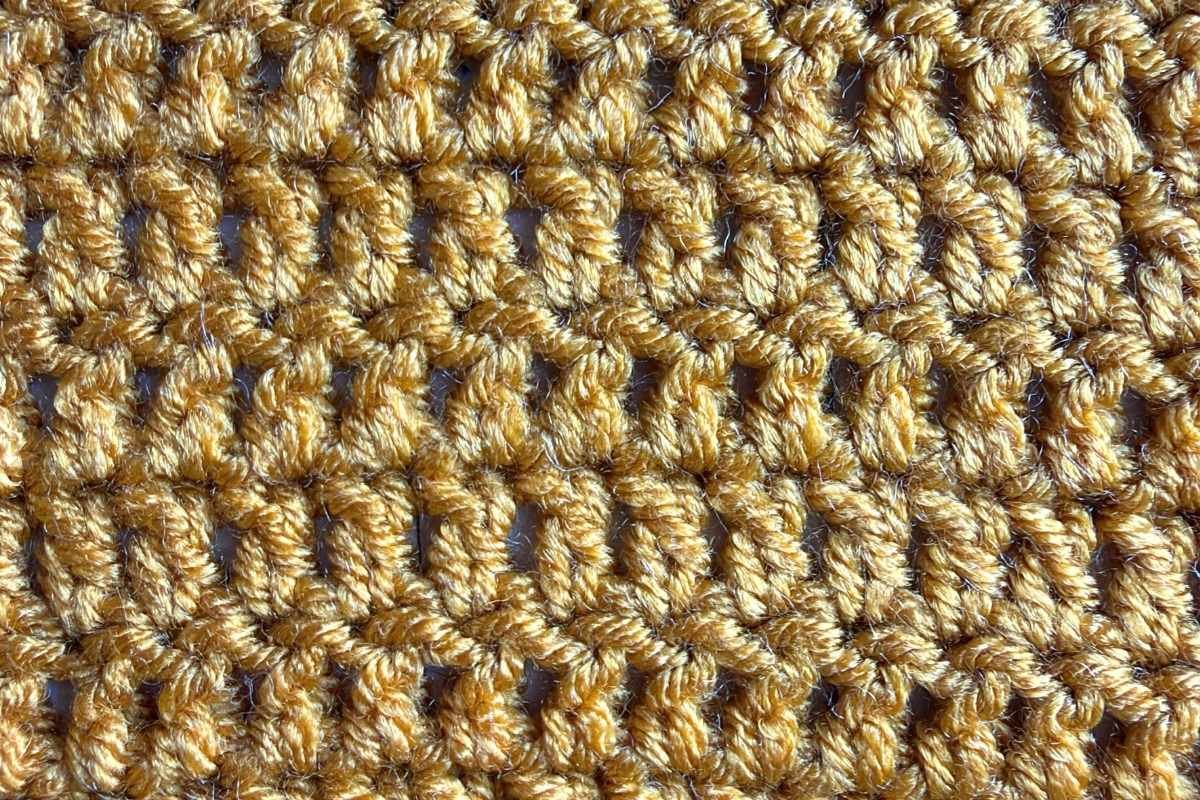
The double crochet stitch is one of the most useful basic crochet stitches to learn. It’s taller than both single crochet and double crochet, which means your fabric grows quickly while still maintaining plenty of structure.
Double crochet creates a softer more open fabric than shorter stitches making it especially useful for garments, blankets, scarves, shawls and countless decorative stitch patterns. Once you understand the simple sequence of yarn overs and pull throughs the stitch develops a lovely rhythm and is surprisingly quick to work.
In this tutorial you’ll learn how to make a double crochet stitch step by step, how to work double crochet in rows, where to insert the hook, how to count your stitches and how to avoid some of the mistakes beginners commonly make.
Double Crochet Stitch at a Glance
- Skill level: Beginner
- US term: Double Crochet
- UK equivalent: Treble Crochet
- US/UK abbreviations: dc/tr
- Stitch height: Tall
- Turning chain: Chain 3
- Turning chain counts as a stitch: No for the method used in this tutorial; always check individual pattern instructions.
- Stitch multiple: Any number of stitches
- Row repeat: 1 row
- Fabric: Soft, flexible and more open than single or half double crochet
- Best for: Blankets, garments, scarves, shawl, granny-style patterns, home decor and more.
What is the Double Crochet Stitch?
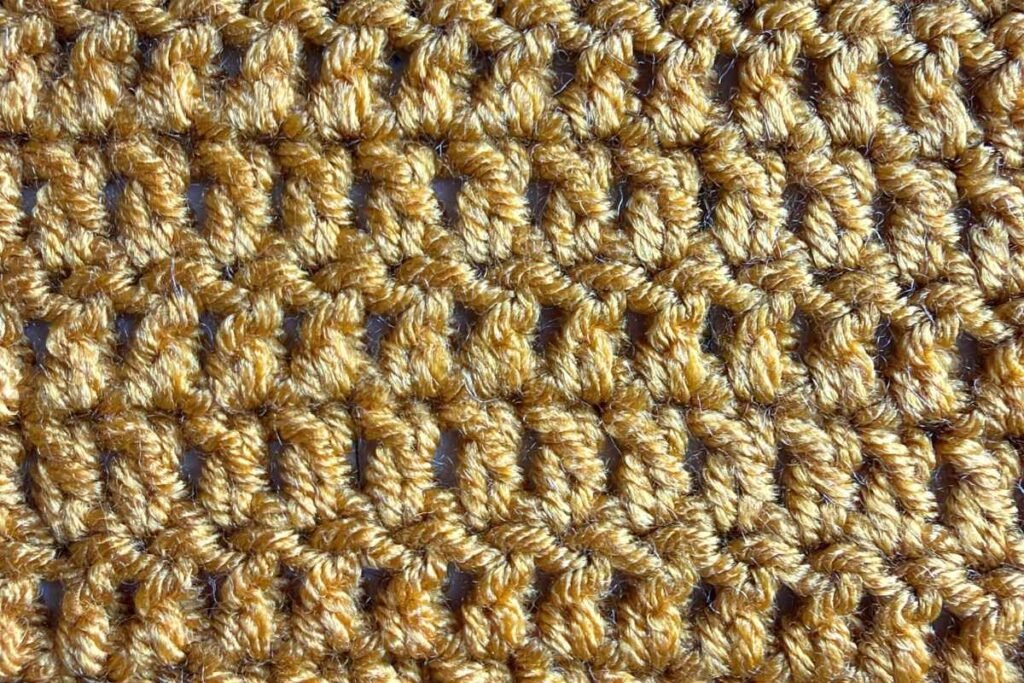
The double crochet stitch, abbreviated dc in US crochet terminology, is one of the fundamental stitches used in crochet. It begins with a yarn over before the hook is inserted into the stitch. After pulling up a loop, there are three loops on the hook. Instead of pulling through all three at once, as you would with half double crochet, the loops are worked off the hook in two stages.
You yarn over and pull through two loops, then yarn over once more and pull through the final two loops. That extra height makes double crochet noticeably taller than single and half double crochet and also creates more space between the stitches.
In Uk terminology, the same stitch is called a treble crochet, abbreviated tr. This is one of those terminology differences worth remembering because a US double crochet and a UK double crochet are not the same stitch.
What Does Double Crochet Look Like?
Double crochet creates tall stitches with a clearly defined vertical post. Across the top of each stitch you’ll see the usual V-shaped pair of loops, while the longer post underneath gives the fabric its characteristic height. Because double crochet stitches are taller, there is more visible space between them than you would normally see in single or half double crochet. The finished fabric tends to feel lighter and more flexible as a result.
That combination of height and drape is one reason double crochet appears in so many blankets, garments and lace-style patterns.
How to Double Crochet
For this tutorial, make a foundation chain to the length required with three additional chains for turning. The three turning chains will not count as a stitch in the method we’re using.
Step 1: Yarn Over
Wrap the yarn over your crochet hook for back to front.
Step 2: Insert Your Hook
Insert your hook into the fourth chain for the hook. The loop already sitting on your hook does not count as a chain.
Step 3: Yarn Over and Pull Up a Loop
Yarn over again and pull the yarn through the chain. You should now have three loops on your hook.
Step 4: Yarn Over and Pull Through Two Loops
Yarn over and pull the yarn through the first two loops on your hook. You should now have two loops remaining.
Step 5: Yarn Over and Pull Through the Remaining Two Loops
Yarn over once more and pull through both remaining loops. You should now have just one loop left on your hook. One double crochet is now complete.
How to Work Double Crochet in Rows
After making the first double crochet, work one double crochet into each remaining chain across the row. When you reach the end turn your work. Chain 3 to bring your hook up to the height of the next row. For the method used in this tutorial, the chain 3 does not count as a stitch.
Work your first double crochet into the first stitch of the previous row, directly at the base of the turning chain. Continue working one double crochet into each stitch across. Because the turning chain is not being counted as a stitch, you’ll work your final double crochet into the final actual stitch of the row rather than into the top of the turning chain.
Count your stitches at the end of each row, particularly while you’re learning. Maintaining the same stitch count is one of the easiest ways to spot a missed or accidental extra stitch before it starts changing the shape of your fabric.
Does the Turning Chain Count as a Double Crochet?
This is one area where crochet patterns can differ. Traditionally, many patterns use a chain 3 that counts as the first double crochet of the row. In that method you normally skip the first stitch and work the final stitch of the following row into the top of the turning chain.
Other designers use a turning chain that does not count as a stitch and work the first double crochet directly into the first stitch. For this tutorial we are using the second method: chain 3, do not count it as a stitch and work into the fist stitch.
Neither method is inherently wrong. The important thing is to use the method specified by the pattern you’re following and to remain consistent throughout the project.
Where Do You Insert Your Hook?
When working a standard double crochet into an existing row, insert your hook underneath both loops of the V at the top of the next stitch. The loop closest to you is called the front loop while the loop furthest away is the back loop. Working underneath both loops is considered the standard placement unless a pattern specifically tells you otherwise.
You can also work double crochet through only the front or back loop to create different textures and ridges.
How to Count Double Crochet Stitches
Look along the top edge of your work and find the V-shaped loops. Each V represents one double crochet stitch. You can also recognise the tall vertical post underneath each V, which makes double crochet stitches relatively easy to distinguish once you know what you’re looking for.
Do not count the loop currently sitting on your hook. For the method used in this tutorial you also don’t count the turning chain as a stitch.
If you’re new to crochet, placing a stitch marker in the first and last double crochet of each row can make the edges much easier to recognise.
How to Count Double Crochet Rows
Double crochet rows are usually fairly easy to identify because of the height of the stitches. Hold your work flat and look for the horizontal bands of tall stitches running across the fabric. Each band represents one completed row. You can also count along one side of the fabric, where the stacked edge stitches make the beginning and end of each row easier to see.
Common Double Crochet Mistakes
Forgetting the Yarn Over
Double crochet begins with a yarn over before inserting the hook. If you insert the hook without yarning over, you’ll begin making a shorter stitch instead.
Pulling Through All Loops at Once
After pulling up a loop, you should have three loops on your hook.
A double crochet is completed in two pull-through stages: yarn over and pull through two loop, then yarn over and pull through the remaining two. Pulling through all three loops at once creates a half double crochet instead.
Losing the Last Stitch of the Row
Because double crochet stitches are tall, the final stitch can sometimes lean towards the edge and be easy to overlook. Missing it repeatedly will make your work gradually become narrower. A stitch marker in the first and last stitch is a simple way to prevent this while you’re learning.
Adding an Extra Stitch at the Beginning
Turning chains are a common source of accidental extra stitches. For this tutorial the chain 3 does not count as a stitch, so after turning you work one double crochet into the first actual stitch. Don’t also treat the turning chain as an additional double crochet.
Uneven Edges
If the edges of your double crochet fabric look wavy or uneven, first check your stitch count.
Uneven tension can contribute, but accidentally skipping or adding stitches at the beginning and end of rows is often the real culprit.
Double Crochet Variations
The basic double crochet stitch can be changed in several simple ways to create different textures.
- Double Crochet Back Loop Only (DCBLO): Worked through the back loop, creating horizontal ridges across the fabric.
- Double Crochet Front Loop Only (DCFLO): Worked through the front loop while leaving the back loop unworked.
- Front Post Double Crochet (FPdc): Worked around the post of the stitch rather than through its top loops, creating raised texture.
- Back Post Double Crochet (BPdc): Worked around round the post from the opposite direction, creating texture.
- Extended Double Crochet: Includes an additional step that makes the stitch slightly taller than a standard double crochet
Front and back post double crochet are especially useful because combining them can create crochet ribbing, cables and highly textured stitch patterns.
Double Crochet FAQs
Is Double Crochet Easy for Beginners?
Yes. Double crochet is considered one of the basic beginner crochet stitches. It involves a few more movements than single crochet but the repeated sequence quickly becomes easy to remember.
Is Double Crochet Taller Than Half Double Crochet?
Yes. Double crochet is taller than half double crochet because its loops are worked off the hook in two separate stages. The additional height also makes the resulting fabric more open and flexible.
What is Double Crochet Called in the UK?
A US double crochet is called a treble crochet in UK terminology. The US abbreviation is dc, while the UK abbreviation for the equivalent st tech is tr.
How Many Chains Do You Need to Turn Double Crochet?
A turning chain of three chains is commonly used for double crochet because it approximates the height of the stitch. Whether those chains count as the first stitch varies between patterns.
Why Are My Double Crochet Edges Getting Wider?
If your work is gradually getting wider, you’re probably adding an extra stitch somewhere. A common cause is working into both the first stitch and treating the turning chain as another stitch. Count your stitches after every row until you’re comfortable identifying the edges.
Why Is My Double Crochet Getting Narrower?
If the fabric becomes narrower with each row, you’re most likely missing the first or last stitch. using stitch markers at both edges can help you identify those stitches before turning.
Explore More Crochet Stitches
Love Discovering New Crochet Stitches?
Get new free crochet stitch patterns and tutorials delivered straight to your inbox.